RESOURCES. CONNECTIONS. TRAINING. PROFESSIONAL GROWTH.
LMT’s programming was designed to provide the resources we all wish we had on our journey as students and teachers. Every LMT offering fills gaps in training, teaching, connection, and professional growth. They are the tools, systems, and experiences that LMT’s stakeholders asked for, needed, or dreamed of. Now, no one has to go without them.
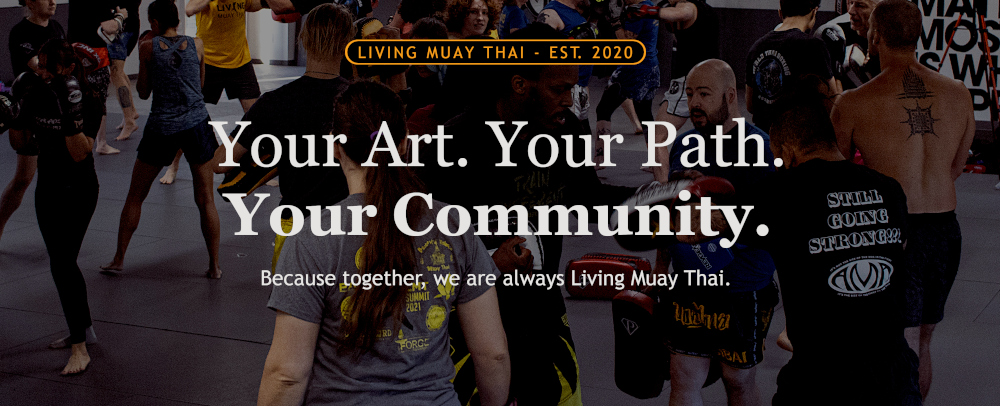
LMT IS community. LMT’s priority is to bridge gyms, educators, and students who would otherwise fight alone. Built around the shared values of hard work, curiosity, and legacy, every LMT offering and every member, educator or student, supports and contributes to the future of Muay Thai. Together.
LMT is an intentional community where members care for one another’s well-being in and out of the ring, on and off the mat. Gyms share resources, staff, knowledge, and support across geographic and organizational lines. Community is both the foundation that supports LMT’s programming and the wrecking ball that demolishes the space between martial educators and the external support we need to be our best.
Training Exchange. All LMT-affiliated gyms welcome learners from other LMT gyms to train for free. Instructors, students, and fighters regularly visit other facilities to prepare for competition, diversify their training, or simply experience a different classroom. The training exchange turns LMT’s network into a living map of open doors. Stay for a week, a month, or a drop-in while traveling. Every LMT gym is YOUR gym.
The Symposium. The LMT Symposium gathers stakeholders — teachers, students, parents, gym managers, product suppliers, spouses, and retired educators — to examine the state of martial education and to discover new pathways forward together. This is not a physical training event. It is a self- and team-discovery event. The Symposium is a space where every voice in the community gets to shape what LMT becomes next, and wherein new knowledge is born and nurtured. Using a design-thinking framework, participants direct the outcomes. The Symposium is an irregularly scheduled event, planned as needed by LMT stakeholders.
Town Hall Meetings. LMT Town Hall meetings are digital gatherings, scheduled regularly throughout the year. The open-to-members social events open the floor to casual or serious discourse, idea generation, and bonding among members who may otherwise wait months to connect. Bring your voice, build your community.
Many martial arts organizations offer a progression system. None offers a complete curriculum driven by an adaptive outcomes program. LMT’s curriculum tells you what you need to learn, why it matters, and how to get there, as well as what paths are available as you succeed. LMT’s Curriculum and Outcomes Program is a high-agency tool. Students and educators have ownership over how they move within the Muay Thai journey. Standards are clear. Pathways to instructorship, coaching, fitness, and competition are defined. But how long the journey takes and how those standards are met is up to each individual and their context. The LMT Curriculum and Outcomes Program ensures excellence while honoring the individual.
LMT offers an adaptive, research-backed pathway to learning and teaching Muay Thai. The LMT curriculum is designed to blend with your gym’s training format while supporting individual student goals. Development is transparent from the beginning and builds on connected learning from the first class through instructorship. Requirements are explicit, with flexible standards that meet every learner and educator where they are.
The LMT curriculum is built to integrate with existing gym programming, not replace it. An affiliated gym keeps its identity, its methods, and its culture. LMT’s curriculum provides a shared backbone of language, standards, and pathways that are consistent across every LMT gym. A student who trains in Cleveland and visits a gym in Miami speaks the same language and brings their own version of the same skills, but will find a unique culture in every gym they visit.
Digital testing, progress tracking from both the student and instructor portals, video of all learning requirements, and automated notifications open the floodgates of learning. You can focus on supporting your students without having to wonder what they need next. The path forward has never been clearer.
At LMT events, we are all truly living Muay Thai. All events are designed around collaboration and engagement. Educators share the responsibility of learning, guiding discovery as students construct knowledge. Students train alongside friends, new and old, from a variety of gyms. The culture is one of shared effort and mutual growth. LMT’s transformative methods ignite the spark, and, together, we fan the flames.
Summits, mini-camps, seminars, and open training exchanges offer year-round, local, regional, and tourist-friendly opportunities to learn, teach, and grow as a team.
The Summit. LMT’s annual flagship event is a four-day training camp built on collaboration, instructor training, and conceptual learning. Each event adheres to a theme, and each day is organized around matching sub-themes. Six classes fill each day, building on one another to ensure deep thematic learning. Optional lunch sessions cover cultural training and educator development. As many as nine instructors share the teaching load, working solo and together throughout the day. The Summit moves to a new location every year to make it accessible to as many people as possible. For many LMT members, the Summit is the game-changer.
Mini-Camps. Shorter, more focused training events held regionally throughout the year. Mini-camps bring LMT instruction closer to home for members who may not be able to travel to the annual Summit. They create additional touchpoints for community learning between the larger events, focusing on the key development needs identified for the year. Every Mini-Camp in a calendar year covers the same key content, with a rotating roster of LMT educators. Mini-Camps and Summits support each other, but cover different content.
Seminars. LMT’s board of educators travels on request to hold educational seminars in Muay Thai technique and educator training methods. Seminars are designed to bring LMT gyms closer together, introduce new communities to LMT’s methods, and spread a common martial vocabulary across the Muay Thai network.
Many martial arts organizations certify instructors. Few train them to teach. LMT’s educator development programming is grounded in the belief that a martial educator must be good at two things: martial art AND teaching. Skill in one area does not guarantee skill in the other. Our research-backed educator training methods ensure that both pillars are strong enough to carry the weight of your practice.
LMT’s educator training includes structured workshops on high-impact teaching tools, formative assessment, transparent learning objectives, student-teacher relations, and instructional design. These practical, applicable methods shape a class’s effectiveness from start to finish. Workshop-style application-oriented study is just the start. Educator development is woven into every LMT event, modeled in every class taught by the board, and available as a dedicated focus for affiliates who want deeper engagement.
Peer-to-peer learning is a cornerstone of educator development. LMT educators observe each other, exchange methods, give honest feedback, and build together. Educational isolation and teaching without observation, path, and feedback end here. In LMT, peers, mentors, and collaborators are invested in your development.
LMT’s boots-on-the-ground, evidence-based educator training is built for the people behind the pads. High-impact teaching tools, instructional design, and peer-to-peer learning frame the path to becoming the best educator you can be.